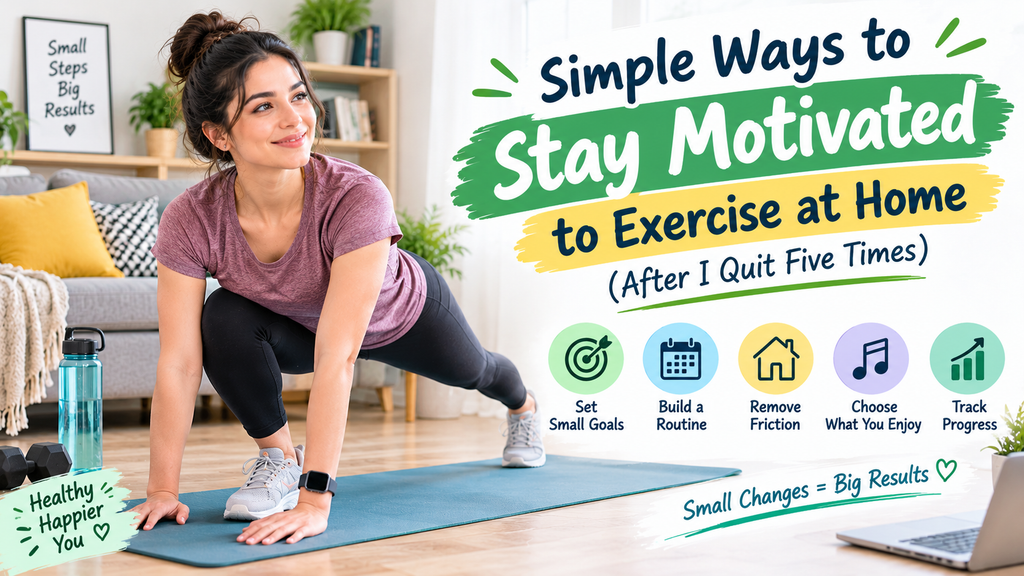
I quit home workouts five times before this finally worked. Simple, realistic ways to stay motivated to exercise at home.
I have a yoga mat that has been rolled up behind my sofa since January. For a long stretch, it was less a piece of fitness equipment and more a quiet reminder of a promise I’d made to myself and ignored.
Simple Ways to Stay Motivated to Exercise at Home The pattern was always the same. I’d start strong on a Monday. Twenty-minute workout, a smug feeling, a photo of my trainers by the door. By Thursday I was “too tired.” By the following Monday, I’d forgotten the whole thing, and the mat went back behind the sofa.
I did this five or six times over about two years. Each restart felt like a fresh chance, and each ending felt like proof that I wasn’t a “workout person.”
What finally broke the cycle wasn’t a better programme or a burst of willpower. It was figuring out why I kept stopping, then fixing those specific problems. This article is what I learned, including the stuff that flopped.
A quick note first: I’m not a doctor or a qualified trainer, just someone who struggled with this and found some things that helped. If you have a health condition, an injury, or you haven’t exercised in a long time, check with a healthcare professional before starting. Stop if anything hurts in a sharp or worrying way.
Why Home Workouts Are Harder to Stick To Than You’d Think
Everyone says working out at home is easier. No commute, no membership fee, no waiting for equipment. In theory, yes.
In practice, home has a few problems the gym doesn’t:
- Everything else is right there. The washing, the dishes, the sofa, the phone, the fridge.
- Nobody’s watching. There’s no one to notice if you skip.
- No clear line between “workout” and “rest.” The living room is for relaxing, so working out in it feels odd.
- No built-in schedule. A gym class starts at 6 p.m. whether you want it or not. Your living room doesn’t care.
Once I saw it this way, I stopped blaming myself. It wasn’t a character flaw. It was a setup problem, and setup problems can be fixed.
What Actually Worked
I’m going to go through these in the order that mattered most to me, not in some neat top-ten ranking.
1. Make the Starting Line Ridiculously Small
My old plan was a 30-minute workout, five days a week. That’s a lot to ask on a day when you’re tired and the weather is grey.
What worked instead was a rule I borrowed from habit research: make the starting version so small it feels almost silly. Mine was “put on workout clothes and do five minutes.” That’s it. If I wanted to stop after five minutes, I was allowed.
Simple Ways to Stay Motivated to Exercise at Home The funny thing is, most days I didn’t stop. Getting started was the hard part. Once I was moving, carrying on felt easy. On the days I did stop after five minutes, I still counted it as a win, because the habit stayed alive.
Mistake I made: I used to think a five-minute workout “didn’t count.” It does. A small thing done regularly beats a big thing done once.
2. Pick a Time and Attach It to Something You Already Do
Vague plans like “I’ll exercise this evening” never worked for me. Evening arrives, I’m tired, and the plan evaporates Simple Ways to Stay Motivated to Exercise at Home .
What helped was linking exercise to an existing routine. After I make my morning coffee, I do ten minutes. That’s the rule. The coffee is the trigger, and the workout follows automatically.
Some triggers that work for people I know:
- After brushing your teeth in the morning
- Straight after finishing work, before you sit down
- While the kettle boils or dinner cooks
- Right after you put the kids to bed
Try a few and keep whichever one feels natural. Mine took two weeks of fiddling before I found a slot that stuck.
3. Remove the Friction
Friction is anything that makes starting harder. I had loads.
My mat was behind the sofa. My weights were in a cupboard. My workout clothes were in a drawer under other things. Each small hurdle added up.
I fixed it like this:
- Mat unrolled in a corner or leaning against the wall, ready to use
- Resistance bands in a basket by the sofa
- Workout clothes laid out the night before (or even slept in, on a lazy day)
- A bottle of water already filled
It sounds trivial, and it is. But it removed about five excuses at once.
4. Choose Workouts You Don’t Hate
For months, I made myself do workouts I found dull, because they were “effective.” I did burpees, which I loathe, because a website said they were the best exercise ever.
I quit, obviously.
When I switched to things I actually enjoyed, like dance workouts, beginner yoga, and brisk walks around the block with a podcast, I kept going. Motivation didn’t suddenly appear. I just stopped fighting myself.
Options I’ve tried or seen friends enjoy:
- YouTube. Channels like Yoga With Adriene, Fitness Blender, and The Body Coach have beginner-friendly sessions. Free and huge variety.
- Nike Training Club. Free workouts with clear instructions.
- Apple Fitness+ or similar subscriptions, if you want polished, guided sessions and are happy to pay.
- Dance videos or dance games if you like music and movement.
- Skipping rope, stair climbing, or a short HIIT routine for something quick.
Try a few and notice how you feel afterwards. The best workout is the one you’ll do again next week.
5. Track Something, But Keep It Light
I need to see progress to stay interested. But my first attempt at tracking was too much. I recorded reps, sets, weights, calories, and mood in a complicated spreadsheet. I quit tracking after nine days.Simple Ways to Stay Motivated to Exercise at Home
What worked was one simple thing: a tick on a paper calendar for each day I moved. That’s all. After a week, there was a chain of ticks, and I didn’t want to break it.
If you prefer apps, some good options are:
- Apple Health or Google Fit for built-in activity tracking
- Strava for walks, runs, and rides, with a social side if you like it
- Streaks (iPhone) or a basic habit tracker app for ticking off days
- A smartwatch or fitness band, if you like data, though it’s not necessary
My rule is: if tracking starts to feel like homework, simplify it.
6. Find Someone to Be Accountable To
I’m someone who needs a tiny bit of external pressure. Without it, I let myself off the hook.
I tried a few things:
- A friend who does workouts at the same time. We video-call, say hello, do our own thing, and say goodbye. It’s oddly effective.
- A group chat. Three of us send a quick “done” message after exercising. No judgement if someone misses a day.
- Online communities. Some people find Reddit fitness communities or Strava clubs helpful.
- A paid class, such as an online live session, which has a set time and a real instructor.
You don’t need to announce it to the world. One person who’ll notice if you vanish is enough.
7. Prepare for Bad Days Before They Arrive
Bad days are inevitable. I used to treat a missed workout as a disaster. Now I plan for it.
Simple Ways to Stay Motivated to Exercise at Home My “bad day rule” is simple: do the smallest version. That might be five minutes of stretching, a ten-minute walk, or a few squats while the kettle boils. It keeps the habit going and avoids the “I’ve missed three days, I might as well give up” spiral.
Another trick: have a short “emergency” workout ready, like a five-minute routine saved on your phone. When you can’t be bothered thinking, you just press play.
8. Reward the Behaviour, Not Just the Result
I used to measure success by weight or appearance.Simple Ways to Stay Motivated to Exercise at Home Those change slowly and aren’t always visible. I’d get discouraged long before anything changed.
Instead, I started rewarding the action. After finishing a week of workouts, I’d treat myself to something small: a nice coffee, a new playlist, an hour with a book. Nothing extravagant, and nothing food-based if that was a trap for me.
I also noticed other benefits that kept me going: better sleep, more energy in the afternoon, and feeling less stiff. Paying attention to those gave me reasons beyond the mirror.
9. Change the Environment (A Little)
Working out in the same spot every day can get dull. Small changes help.
- Move the mat to a different room
- Open a window or exercise near natural light
- Put on music you love
- Try a workout outside, in the garden or park, when the weather allows
- Wear something that makes you feel good
I even found that a tidy space helped. Tripping over laundry while doing lunges is not inspiring.
10. Be Kind When You Slip
This was the hardest lesson. For years, every missed day came with a stream of self-criticism. It made me feel worse, which made me less likely to try again.
What changed things was treating a missed workout the way I’d treat a friend’s: “No worries, tomorrow’s a new day.” I didn’t have to earn my way back with extra punishment sessions.
Consistency matters more than perfection. If you miss one day, you haven’t failed. You’ve just paused.
A Simple Step-by-Step Way to Get Started
If you want a straightforward plan, here’s how I’d begin again from scratch.
Step 1: Define a tiny goal. Pick something you could do on your worst day. For example: “Five minutes of movement after breakfast.”
Step 2: Choose a trigger. Link it to something you already do every day, like making a drink or finishing work.
Step 3: Set up your space. Lay out your mat, clothes, and water. Make it visible and easy.
Step 4: Pick one or two workouts you like. Don’t browse for an hour. Choose a video or app, bookmark it, and save it in a favourites folder.
Step 5: Do it for a week. Tick each day on a calendar. Don’t worry about intensity. Just show up.
Step 6: Add a little. In week two, extend to ten minutes or add another day. Increase gradually.
Step 7: Find a buddy or a check-in. Tell someone what you’re doing, or join an online group.
Step 8: Review after a month. Look at what’s working. Keep it, drop what isn’t, and adjust.
Mistakes I Made (So You Can Skip Them)
Starting too big. My early plans were ambitious and unsustainable. Small starts last longer.
Waiting to “feel motivated.” Motivation is unreliable. Action often comes first, and the good feeling follows.
Copying someone else’s routine. What works for a 22-year-old fitness influencer may not suit you. Choose what fits your body and life.
Ignoring rest. I once did a hard workout six days in a row and ended up exhausted and sore. Rest days are part of the process.
Skipping the warm-up. A few minutes of gentle movement helps your body get ready and lowers the chance of silly strains.
Comparing myself to others. Social media can make home workouts look more impressive than most people’s real lives. Compare yourself only with your past self.
Buying lots of gear. I bought resistance bands, a kettlebell, a balance board, and a foam roller in a burst of enthusiasm. I used the bands. The rest gathered dust. Start with what you have.
Quitting after a missed week. The comeback matters more than the gap. Start again with the smallest version.
Real-Life Scenarios
If you’re tired after work: Do a short, gentle session, like stretching or a walk. Save intense workouts for mornings or weekends if that suits you better.
If you have kids at home: Include them. Dance in the living room, do a family walk, or exercise while they play nearby. It doesn’t have to be quiet or perfect.
If you live in a small space: Use low-impact moves that need little room, such as squats, glute bridges, and stretches. A yoga mat or a patch of floor is enough.
If you share your home: Agree on times, use headphones, and choose quieter exercises if noise is a problem.
If the weather is miserable: Keep a short indoor routine ready. Marching on the spot to a favourite playlist counts.
If you feel self-conscious: Home is a good place to start. No one’s watching, and you can build confidence before trying anything else.
Who Should Take Extra Care
If you have a heart condition, high blood pressure, diabetes, joint problems, are pregnant, or you’re recovering from illness or injury, please speak with a doctor or physiotherapist before starting a new exercise routine. If you feel dizzy, get chest pain, or experience unusual shortness of breath, stop and seek advice.
Final Thoughts
My yoga mat is no longer behind the sofa. It’s in the corner of the living room, unrolled, with a little basket next to it. Most mornings, I do ten minutes after my coffee. Some days I do more. Some days I do five and call it done.
It isn’t impressive, and that’s the point. The routine works because it’s small, easy to start, and forgiving when life gets in the way.
If you only change one thing today, put your mat or your trainers somewhere you can see them. Then pick a trigger, set a five-minute goal, and try it tomorrow. Everything else can wait until the habit has settled.