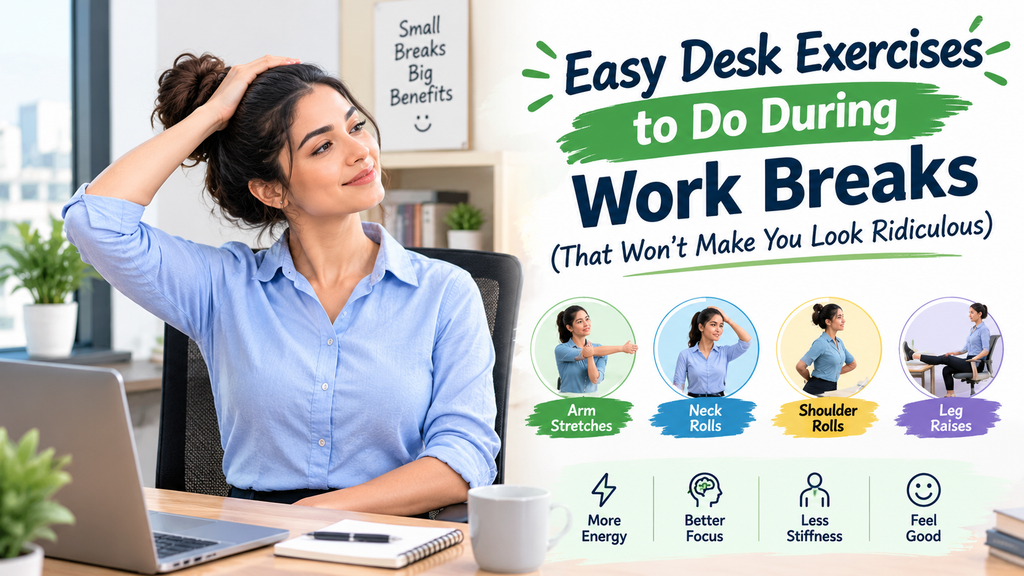
My back clicked after long days of sitting. These easy desk exercises fit into two-minute work breaks and need no gym.
Around month three of working from a spare-room desk, I stood up after a long afternoon of calls and my lower back made a noise I can only describe as a sticky drawer being forced open. My right hip felt locked. My neck had settled into a permanent forward tilt, like a tortoise leaning toward a laptop.
I was 34. I wasn’t doing anything dramatic. I was just sitting. For about nine hours a day, with a coffee mug as my only regular reason to leave the chair.
That was the moment I took it seriously. Not because anything was seriously wrong, but because I realised the “I’ll stretch later” plan had a flaw: later never came.
What follows is what I actually do now, what I tried and dropped, and a few lessons I learned the awkward way. None of it needs equipment, and almost all of it can be done in work clothes, in a chair, without anyone on a video call noticing.
One quick note first. I’m not a doctor or a physiotherapist, just someone who sits too much and got tired of aching. If you have a health condition, an injury, or ongoing pain, check with a healthcare professional before starting anything new. Sharp pain, numbness, or dizziness mean stop and get advice.
Why Short Breaks Beat Big Plans
I used to think the answer was a proper workout after work. In practice, by 6 p.m. I was drained, hungry, and unwilling.
What changed things was learning that breaking up long stretches of sitting matters, not just the exercise you fit in around it. Public health bodies, including the NHS and the WHO, now say that people should cut down on long periods of sitting and move regularly, not only squeeze in one session a day.
You don’t need a big number. A two-minute break every hour adds up to quite a lot across a working week, and it feels like nothing while you’re doing it. That’s the whole trick. The smaller it is, the more likely you’ll actually do it.
The Exercises I Actually Use
I’ve sorted these by what they fix, because that’s how I think about them. Each one takes about a minute or less.
For the stiff neck and shoulders
Chin tucks. Sit tall. Gently draw your chin straight back, as if making a double chin, and hold for three to five seconds. Release. Repeat eight to ten times.
This one genuinely helped my forward-head posture. It feels odd at first, but it’s subtle enough to do mid-meeting.
Shoulder rolls. Roll your shoulders up, back, and down in slow circles. Ten times back, then ten forward. Don’t rush. The slower you go, the more you feel it.
Neck side stretch. Sit up straight and gently tilt your ear towards your shoulder. Hold for 20 seconds each side. Keep the opposite shoulder relaxed and down. No pulling with your hand, just let the weight of your head do it.
Mistake I made: I used to crank my head around aggressively, thinking harder meant better. I woke up with a sore neck the next day. Gentle is the setting that works.
For the upper back and chest
Seated cat-cow. Place your hands on your knees. Breathe in, arch your back, and lift your chest. Breathe out, round your spine and tuck your chin. Repeat eight to ten times.
It looks like nothing. It feels fantastic after a long stretch hunched over a keyboard.
Doorway chest stretch. Stand in a doorway, place your forearms on the frame at about shoulder height, and lean gently forward until you feel a stretch across your chest. Hold for 20 to 30 seconds.
This one counters the rounded-shoulder posture that typing creates.
Desk-edge thoracic extension. Sit tall, clasp your hands behind your head, and gently lean back over the top of your chair, looking up slightly. Hold for a breath or two. This relieves that tight feeling between the shoulder blades.
For the lower back and hips
Seated spinal twist. Sit upright with feet flat on the floor. Place your right hand on your left knee and gently turn your torso to the left, looking over your shoulder. Hold for 15 to 20 seconds, then switch sides.
Seated figure-four stretch. Sit tall, cross your right ankle over your left knee, and gently lean forward with a straight back until you feel a stretch in the hip. Hold for 20 to 30 seconds each side.
My hips love this. Sitting all day tightens them up, and this is the stretch I’d keep if I could only keep one.
Standing hip flexor stretch. Step one foot back into a shallow lunge, tuck your tailbone slightly, and shift your weight forward gently. Hold for 20 seconds each side. Hold onto the desk for balance if you need to.
For legs and circulation
Sit-to-stands. Stand up from your chair without using your hands, then sit back down slowly. Do 8 to 12 reps.
It’s a real leg workout disguised as ordinary behaviour. It’s also what I do while waiting for a file to upload.
Calf raises. Stand behind your chair, hold the back, and rise onto your toes. Lower slowly. Do 12 to 15 reps.
Great while on a phone call. No one can tell.
Ankle circles. Lift one foot off the floor and rotate the ankle in slow circles, ten each way, then switch. This is the one I do when my feet feel puffy after long hours.
Marching on the spot. Stand and lift your knees, gently, for 30 to 60 seconds. It raises your heart rate a touch and wakes you up better than a second coffee.
For tired eyes and wrists
The 20-20-20 habit. Every 20 minutes, look at something at least 20 feet (about six metres) away for 20 seconds. This is a common suggestion from eye-health professionals for reducing eye strain from screens.
Wrist stretches. Extend one arm in front of you, palm up, and gently pull your fingers back with the other hand. Hold for 15 seconds. Then flip your palm down and gently press the back of the hand towards you. Repeat on the other side.
If you type or use a mouse all day, this is worth doing a few times daily. If you have tingling, numbness, or persistent pain in your hands or wrists, speak to a doctor rather than just stretching it out.
A Simple Two-Minute Routine to Start With
If the list above feels like too much, here’s the short version I use on busy days. It takes about two minutes and needs no equipment.
- Stand up and shake it out for ten seconds.
- Chin tucks: 8 reps.
- Shoulder rolls: 10 back, 10 forward.
- Sit-to-stands: 10 reps.
- Calf raises: 12 reps.
- Standing hip flexor stretch: 20 seconds each side.
- Big breath in, slow breath out, twice.
That’s it. Do it once every couple of hours, and you’ve covered neck, shoulders, legs, and hips without touching your lunch break.
How I Made It Stick (Step by Step)
Knowing the exercises isn’t the hard part. Remembering to do them is.
Step 1: Pick one trigger. I attach the routine to something I already do. Every time I finish a meeting, I stand up. Every time I refill water, I do ten calf raises while the tap runs.
Step 2: Use a gentle reminder. I tried a few tools:
- Stand Up! (a free Mac and Windows app) pops up a reminder at set intervals. Simple and effective.
- Stretchly, a free, open-source break reminder for Windows, Mac, and Linux, which I liked because it’s customisable and not annoying.
- Apple Watch or Fitbit stand reminders, if you wear one. They nudge you if you’ve been still for an hour.
- A plain phone timer. Honestly, this works just as well.
I used to set reminders every 30 minutes. They became background noise within a week. Hourly works much better for me.
Step 3: Start with one exercise. My first week was chin tucks only. It sounds absurdly small, but it built the habit of getting up and moving at all.
Step 4: Add one new move every week or so. By week four, I had a routine I could do without thinking.
Step 5: Track it lightly. I put a sticky note on my monitor and put a tick on it each time I finished a break. No app, no data, just ticks. It was weirdly satisfying.
Step 6: Fix your setup too. Exercises help, but a bad setup undoes them. Check your monitor height (the top of the screen around eye level), keep your feet flat on the floor, and make sure your elbows sit at roughly a 90-degree angle. A £15 laptop stand and a separate keyboard changed more for me than any stretch.
Mistakes I Made (So You Can Skip Them)
Treating breaks as a luxury. I felt guilty for stopping. Then I noticed I worked better after a break than when I pushed through. Breaks aren’t slacking.
Stretching cold and too hard. I’d leap into a deep stretch the moment I stood up. A few gentle moves first, like marching on the spot or shoulder rolls, made everything feel better and safer.
Bouncing in stretches. Bouncing can tug at the muscle. Slow, steady holds are kinder.
Holding my breath. It sounds silly, but I often did. Breathing slowly through the stretch made it feel more effective.
Doing everything on one side. I naturally favoured my right side and ended up lopsided. Now I always count both sides.
Expecting overnight changes. It took a few weeks before I noticed my back felt less tight. Don’t judge it after three days.
Ignoring pain signals. A mild stretch feeling is fine. Sharp, burning, or radiating pain isn’t. If something feels wrong, stop.
Real-Life Scenarios
On video calls: Calf raises, ankle circles, and shoulder rolls are invisible off-camera. Chin tucks and seated twists are subtle enough that no one has ever noticed.
In an open-plan office: I stick to sit-to-stands, calf raises, and seated stretches. A short walk to the printer or the water cooler counts too. If you feel self-conscious, standing at the back of a corridor for a hip stretch is usually fine.
On a tight deadline: This is when breaks feel impossible. I do a 30-second version: stand, roll shoulders, breathe out slowly, sit back down. It’s less than a minute, and it keeps me from locking up.
If you work in a small flat: A chair and a bit of wall space is all you need. I use my kitchen counter for hip stretches.
For long phone calls: I put myself on speaker or headphones and pace around the room. It adds a surprising number of steps.
Who Should Take Extra Care
If you have a back or neck injury, a recent surgery, high blood pressure, balance problems, are pregnant, or deal with chronic pain, ask a doctor or physiotherapist which movements are right for you before starting. If any exercise causes pain, numbness, or dizziness, stop and seek advice.
Final Thoughts
A few months after that creaky afternoon, I stood up from my desk and nothing clicked. No locked hip, no stiff neck. It wasn’t a miracle. It was just two minutes every hour, repeated until it became boring.
That’s really the point. These exercises aren’t clever. They work because they’re small enough to do on a day when you’re tired, busy, and in no mood.
If you try one thing today, set a timer for an hour from now, then stand up and do ten chin tucks and ten calf raises. Then see how you feel when you sit back down. Start there, and add the rest when you’re ready.