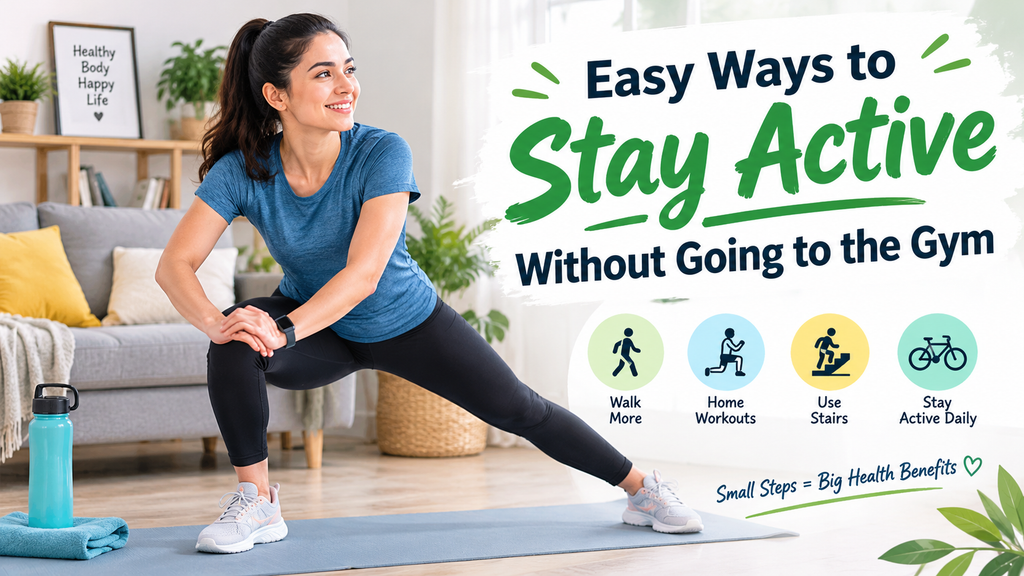
I paid for a gym and barely went.Easy Ways to Stay Active These Without Going to the Gym easy daily walking habits and quick home workouts finally got me moving again.
I paid for a gym membership for eleven months and went maybe fourteen times. I know the number because I checked the app one day, felt my stomach drop, and did the maths on what each visit had cost me. It wasn’t pretty.
The gym wasn’t the problem, exactly. It was a 20-minute walk each way, it got packed right after work, and by the time I’d decided what to do on the machines, I’d already talked myself into going home. Every skipped session made the next one feel more awkward.
So I cancelled. And for about two months I did nothing at all, apart from feeling vaguely guilty every time I climbed a flight of stairs and noticed I was out of breath.
What got me moving again wasn’t a new plan or a fancy gadget. It was a pile of small, slightly boring habits that fit into a day I already had. This article is everything I learned, including the stuff that flopped.
A quick note before we start: I’m not a doctor or a trainer. If you have a health condition, an injury, or you haven’t exercised in a long time, check with your doctor before ramping anything up. Everything below is gentle enough to start with, but your body is your own.
The Real Reason Most of Us Stop
Here’s what I figured out after quitting. I’d been treating exercise as an event. You get changed, you travel, you do “a workout,” you travel back, you shower. That’s a two-hour commitment for a 45-minute session, and any bad day can wreck it.
Being active doesn’t have to be an event. It can be woven through the day in tiny pieces, and those pieces genuinely add up. Health guidelines in the UK and from the WHO, for example, talk about roughly 150 minutes of moderate activity a week for adults. That’s about 20 minutes a day. Not a heroic number. Spread out, it hardly feels like exercise at all.
Once I stopped chasing the “proper workout” idea, things got a lot easier.
1. Walk More, But Give It a Reason
Walking is the obvious answer, and it’s obvious because it works. The catch is that “go for a walk” is easy to ignore. A walk with a purpose is much harder to skip.
Here’s what stuck for me:
- Walk part of the commute. I get off the bus two stops early. It adds about 12 minutes and I barely notice.
- Take phone calls on foot. If a call doesn’t need my laptop, I pace around the block. A 30-minute call is suddenly a 30-minute walk.
- Do one errand on foot each day. Post office, pharmacy, a coffee from the place further away. Nothing dramatic.
- Walk after dinner. Ten to fifteen minutes. It became my wind-down ritual, and it’s honestly my favourite part of the day now.
I started tracking steps with the free Health app on my iPhone (Google Fit does the same job on Android). I didn’t buy a watch. I just wanted a rough idea of what a normal day looked like.
My first week’s average was around 3,000 steps. That was a shock. I’d assumed I was doing fine.
A mistake I made: I set a goal of 10,000 steps on day one. By day three I was frustrated and had given up. The 10,000 figure is popular, but it isn’t magic. I reset my target to 1,000 more than my average each week, and that worked far better.
2. Do “Exercise Snacks” Throughout the Day
This was the biggest shift for me. Instead of one long session, I started doing very short bursts of movement spread across the day.
Think two or three minutes at a time:
- 10 squats while the kettle boils
- A minute of stair climbing between meetings
- 10 wall push-ups after I send an email
- A short stretch every time I stand up from my desk
It feels silly the first few days. But it’s easy to start, and there’s no changing clothes, no travel, and no pressure. I can do it in my work clothes.
I used to scoff at this, honestly. How could ninety seconds of squats matter? But the consistency is the point. Doing something small, every day, beat doing something big, twice a month.
3. Use What’s Already in Your Home
You don’t need equipment. I own one pair of cheap resistance bands (about £10) and a yoga mat that doubles as my floor cushion. Everything else is bodyweight.
A simple routine I rotate through, about 15 minutes in total:
- Squats: 12 to 15 reps
- Incline push-ups (hands on the sofa or a sturdy table): 8 to 12 reps
- Glute bridges: 12 to 15 reps
- Plank: 20 to 30 seconds, building up slowly
- Standing marches or step-ups on the bottom stair: one minute
I do this circuit two or three times, with a minute’s rest between rounds. That’s it.
For guidance, I use a few free resources instead of inventing workouts from scratch:
- YouTube. Channels like Fitness Blender and Yoga With Adriene have a huge range of beginner sessions, from 10 minutes upward.
- Nike Training Club. The app has free workouts with clear instructions. Some content is paid, but I’ve never needed it.
- Seven. A short-workout app built around quick sessions. It’s useful if you like structure. The full version is a paid subscription, so try the free portion first.
Lesson learned: My first attempt at home workouts was a random YouTube “30-day challenge” with an advanced-looking instructor. I couldn’t keep up, felt rubbish, and quit in a week. Starting at beginner level wasn’t embarrassing. It was the only reason I kept going.
4. Turn Chores Into Movement
This sounds like something from a magazine, but hear me out. Housework is real physical activity if you do it with a bit of energy.
- Vacuuming, mopping, and scrubbing the bath all raise your heart rate more than you’d think.
- Gardening, even just weeding or carrying watering cans, counts.
- Carrying shopping home instead of driving burns a surprising amount of effort.
- Putting on music and cleaning at a decent pace makes it feel less like work.
One Saturday I tracked a 40-minute tidy-up on my phone, and it logged a solid chunk of active minutes. I’d never have called it a workout, but my body thought otherwise.
5. Make Your Desk Less of a Trap
If you work at a desk like I do, sitting for hours is the real enemy. I’m not saying a standing desk will change your life (I tried one, and honestly, standing still for hours is tiring in its own way). What helped more was interrupting the sitting.
What I do now:
- Set a gentle timer. Every 45 to 60 minutes, I stand up and move for a couple of minutes. I use a simple free browser extension for this, but your phone’s timer works fine.
- Drink water often. Partly for hydration, partly because it forces me to get up for refills and bathroom trips.
- Use a further printer or bin. I moved my rubbish bin across the room on purpose.
- Walking meetings. If it’s a catch-up with a colleague and no screen is needed, I suggest a stroll.
It’s minor stuff, but I noticed my back stopped aching by the end of the day, which was a bigger motivator than any fitness goal.
6. Pick Something Fun, Not Just “Good for You”
The activities I’ve stuck with longest are the ones I actually enjoy. That seems obvious, but I ignored it for years.
Some ideas that worked for me or friends of mine:
- Dancing in the kitchen. Terrible dancing, great workout.
- Cycling. Even a secondhand bike and a loop around the neighbourhood.
- Swimming at a local pool, for those who like water.
- Hiking or park walks with a friend, a podcast, or both.
- Beginner yoga at home for stretching and balance.
- Skipping rope. Ten minutes is far tougher than it looks.
- Local park runs. In the UK, parkrun is free, friendly, and welcomes walkers as well as runners.
For tracking and a bit of friendly motivation, I use Strava for walks and rides. Seeing my route on a map somehow makes me want to do it again. Fitbit and Garmin devices work well too, if you like gadgets, but I wouldn’t buy one until you know you’ll use it.
A Simple Step-by-Step Way to Start
If all of this feels like a lot, here’s the order I’d follow if I were starting over.
Step 1: Find your baseline. For one week, don’t change anything. Just notice how much you move. Use your phone’s step counter and write down the number each night.
Step 2: Add one habit only. Pick the easiest thing. For most people, that’s a 10-minute walk after a meal. Do it every day for two weeks before adding anything else.
Step 3: Attach it to something you already do. Habits stick when they’re tied to existing routines. “After I make my morning tea, I do 10 squats.” “After dinner, I walk round the block.” Don’t rely on motivation. Rely on triggers.
Step 4: Add a short home routine. After a couple of weeks, add the 15-minute bodyweight circuit twice a week. Keep it easy at first. If you can chat while doing it, you’re in a good place.
Step 5: Increase slowly. Add a few minutes or a few reps each week. Not each day. My knees thanked me for being patient.
Step 6: Track it simply. A paper calendar with a tick for each active day works brilliantly. I stuck mine on the fridge. Seeing a chain of ticks became oddly motivating, and I hated breaking it.
Step 7: Plan for bad days. You’ll have them. On those days, my rule is: do the smallest version. Five minutes, not zero. It keeps the habit alive.
Mistakes I Made (So You Can Skip Them)
Going too hard, too fast. In week two, I did a long home workout and could barely walk down the stairs for three days. Sore muscles are normal at the start, but being unable to move isn’t a great motivator. Ease in.
Skipping the warm-up. I thought a warm-up was a waste of time for a short routine. Then I tweaked my lower back doing squats cold. Two or three minutes of marching on the spot and gentle arm circles is worth it.
Judging progress by the scale. I got hung up on weight early on and nearly quit when it didn’t move. What improved first was my energy, my sleep, and how I felt climbing stairs. Those matter more to me now.
Copying someone else’s routine. What works for a 25-year-old fitness influencer might not suit you. Your schedule, body, and energy are different.
Relying on motivation. Motivation is great when it shows up. It doesn’t show up reliably. Systems and habits do the heavy lifting.
Ignoring pain. Muscle fatigue is one thing. Sharp or joint pain is another. If something hurts in a way that feels wrong, stop and get it checked.
All-or-nothing thinking. If I missed a day, I used to write off the whole week. Now I just carry on the next day. Missing once is nothing. Missing and quitting is the real problem.
A Few Real-Life Scenarios
If you work long hours: Squeeze movement into the cracks. Stairs instead of lifts, a ten-minute walk at lunch, and a short stretch before bed. You don’t need an hour.
If you have young kids: My sister does squats and lunges while her toddler plays on the floor, and they both laugh about it. Walks with a pushchair count. So does chasing a child around the garden.
If you’re short on space: A flat or small room is enough. Most bodyweight moves need about the space of a yoga mat. If noise is an issue, pick low-impact moves like glute bridges, slow squats, and stretches.
If the weather is miserable: Keep an indoor backup. A 10-minute video, marching in place while watching TV, or climbing up and down a staircase works when it’s pouring outside.
If you feel self-conscious: Home workouts are great for this. No one’s watching. Start where you are, and nobody needs to know.
Who Should Be Careful
If you have a heart condition, high blood pressure, diabetes, joint problems, are pregnant, or you’re recovering from illness or injury, please talk to a healthcare professional before starting. They can tell you what’s safe for you. Stop and seek advice if you feel dizzy, get chest pain, or have unusual shortness of breath.
Final Thoughts
It’s been about a year since I cancelled that gym membership. I’m not a fitness fanatic. I didn’t transform overnight. Most days I’m just someone who walks a bit, does a short set of squats while waiting for the kettle, and stretches on a mat in the living room.
But I’m moving more than I ever did when I was paying for a gym I didn’t use. That’s the part that matters.
If you take one thing from this, make it small. Pick a single habit, tie it to something you already do, and give it two weeks. The rest tends to follow quietly, without the guilt and without the commute.
Start with the walk after dinner. It’s the easiest thing on this list, and it was the first thing that worked for me.